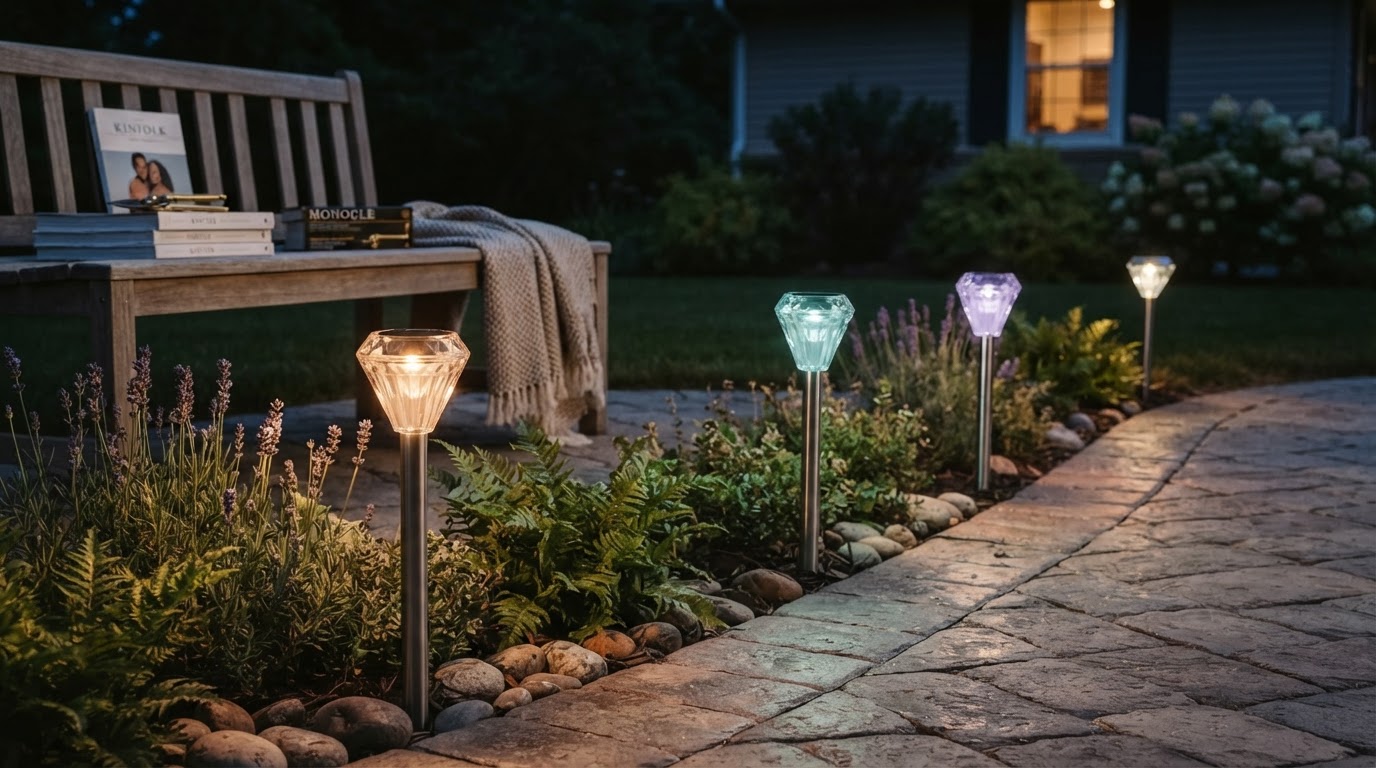
Solar Garden Color Lights for Dark Backyard Safety
 Priya RamanSenior Analyst
September 16, 2026. This analysis examines the technical implementation of high-output solar illumination to mitigate safety hazards in unlit residential landscapes. It is intended for homeowners seeking to balance perimeter security with aesthetic versatility.
The Technical Challenges of Unlit Outdoor Environments
Residential backyards often suffer from uneven light distribution, creating localized dark zones that pose tripping hazards and security vulnerabilities. When assessing these spaces, think of it as a matrix of visibility and atmospheric impact. Standard incandescent solutions require extensive trenching for high-voltage wiring, which is often cost-prohibitive for expansive properties. Furthermore, static white light frequently fails to define the depth of a garden, leading to a flat visual field that obscures changes in elevation or terrain. The lack of solar garden color lights in these areas means that structural elements like stone paths or water features disappear entirely after sunset. Data from consumer search queries indicates a high volume of interest in outdoor solar lights for garden decor, suggesting that homeowners are increasingly looking for solutions that serve both functional and decorative roles. Without proper illumination, the perimeter of a home remains an unused asset for half of the day, yet the environmental cost of traditional hardwired lighting continues to drive interest toward renewable alternatives. The primary difficulty lies in finding a system that provides enough lumens to ensure safety without the harsh glare of industrial security floods.
Implementation of Solar Garden Color Lights Technology
Addressing deep shadows requires a strategic layering of light sources rather than a single high-intensity beam. Two axes matter here: the angle of light dispersion and the spectral versatility of the hardware. Modern solar landscape lighting multi color units utilize high-efficiency photovoltaic cells to store energy during daylight hours, which is then regulated by internal controllers to power multi-diode RGB arrays. These systems allow for the customization of the light temperature and hue, which is critical for maintaining visibility in different weather conditions. For example, waterproof multi color solar lights are specifically engineered to maintain internal circuitry integrity even during heavy precipitation, ensuring that the backyard remains illuminated regardless of the season. By integrating outdoor solar spot lights multi color, a property owner can highlight specific architectural features or dense foliage that would otherwise be lost to the darkness. This targeted approach reduces light pollution by focusing the beam exactly where it is needed. During specific times of year, such as the winter months, holiday solar garden lights color configurations can be deployed to add festive layers without necessitating a complete overhaul of the existing infrastructure. The decision rule for effective backyard lighting is to prioritize high-lumen output for transit paths while utilizing softer, color-changing nodes for peripheral boundaries to create a sense of enclosed space.
Strategic Framework for Backyard Lighting Deployment
Once you see it this way, the process of reclaiming a dark backyard becomes a matter of systematic placement rather than trial and error. A successful deployment requires a balance between functional path lighting and accent illumination to eliminate blind spots. The following framework should be used to evaluate the needs of a specific outdoor area:
- Identify high-traffic transit zones that require constant illumination for foot safety.
- Map out perimeter boundaries to define the visual limits of the property.
- Select fixtures with a minimum IP65 waterproof rating to ensure longevity against the elements.
- Coordinate color temperatures to avoid visual fatigue; warmer tones are generally preferred for relaxation areas.
- Utilize solar garden color lights to create contrast between foreground elements and background foliage.
- Verify the solar panel placement to ensure at least six hours of direct sunlight for peak performance.
Shop Solar Garden Color Lights here.