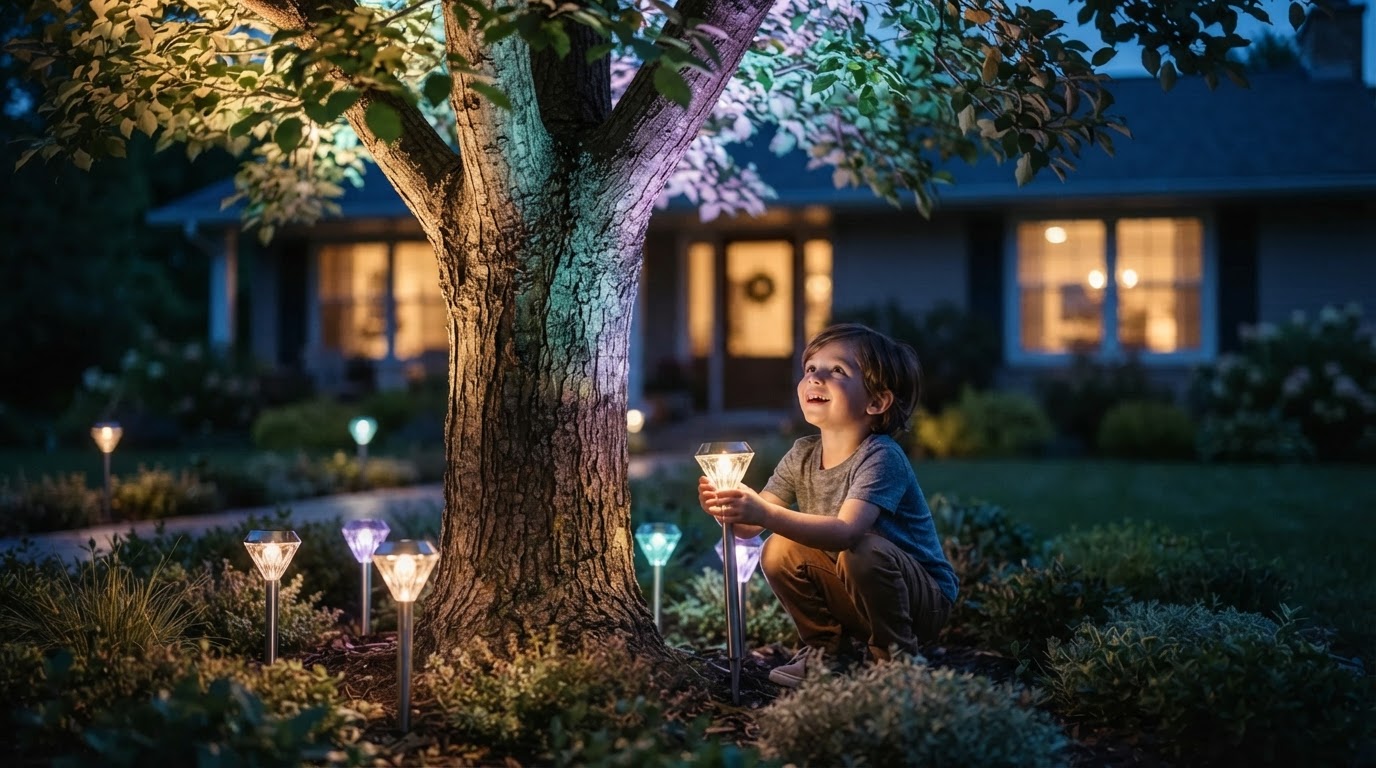
Solar Garden Color Lights Framework for Tree Uplighting
 Priya RamanSenior Analyst
October 26, 2026 — The rising demand for sustainable landscape design has positioned Solar Garden Color Lights as a primary tool for illuminating vertical garden elements without the complexity of wired infrastructure. As homeowners transition toward automated outdoor aesthetics, the application of color-changing technology to mature trees has evolved from a simple novelty into a precise lighting discipline.
Effective tree illumination requires a balance between light intensity and the specific texture of the foliage. According to specifications from Tsun Lighting, high-quality solar landscape spotlights now utilize up to 20 LEDs to offer six distinct colors, including cyan and purple, alongside specialized modes that transition through the spectrum. This technical capability allows for a more nuanced approach than traditional fixed-white lighting, provided the placement accounts for the tree's height and density. When selecting hardware, the focus must remain on the intersection of lumen output and weatherproofing to ensure the light penetrates the canopy effectively throughout the night.
The 4-Point Elevation Framework
To achieve professional-grade results with Solar Garden Color Lights, think of it as a matrix of intensity and angle. The first dimension is the beam spread; narrow beams are reserved for trunk highlighting, while wider washes are necessary for the outer canopy. The second dimension is the lumen density relative to the tree's height. For a standard 15-foot deciduous tree, a spotlight requires a minimum of 200 to 300 lumens to maintain visibility against ambient darkness. Data from Quntis indicates that modern RGB spotlights feature dual lenses and IP65 weatherproof ratings, which are essential for units placed at the base of trees where moisture and soil contact are constant. These units often provide 25 lighting modes, allowing the user to switch from a high-intensity static green for summer foliage to a warmer yellow or red for autumn transitions. The runtime is equally critical; a high-efficiency solar panel must support at least 8 to 10 hours of operation to ensure the aesthetic remains consistent until dawn. The decision rule: if the tree is taller than 20 feet, dual-mounted 20-LED units are required to prevent the light from dissipating before reaching the upper branches. Once you see it this way, the selection process shifts from aesthetic guesswork to a calculation of coverage area and light throw.
Expert tip: When positioning Solar Garden Color Lights for tree uplighting, place the fixture approximately two feet from the trunk and tilt it 60 degrees upward. This creates a grazing effect that highlights the bark texture while minimizing glare for those walking through the yard.
Properly illuminated trees serve as the anchor points for broader rgb solar spotlights for yard installations. For those seeking the most vibrant results, selecting the brightest color solar garden lights ensures that the color saturation remains visible even under moonlight. Consistency is also maintained by optimizing solar garden color lights for year-round use, which involves adjusting the solar panel angle as the sun's path changes in winter. Integrating these elements with rgb solar landscape lighting creates a layered visual depth that standard white lights cannot replicate.
Selecting the right lighting hardware ensures that your landscape remains a focal point in every season. By following a structured approach to placement and intensity, you can transform ordinary greenery into a dynamic architectural feature.
Shop Solar Garden Color Lights.
Sources
- Quntis RGB Color Changing Solar Spotlights, 25 Lighting ...
- SOLAR LED SPOTLIGHTS THAT CHANGE COLORS! ...
- Color Changing Solar Stake Lights