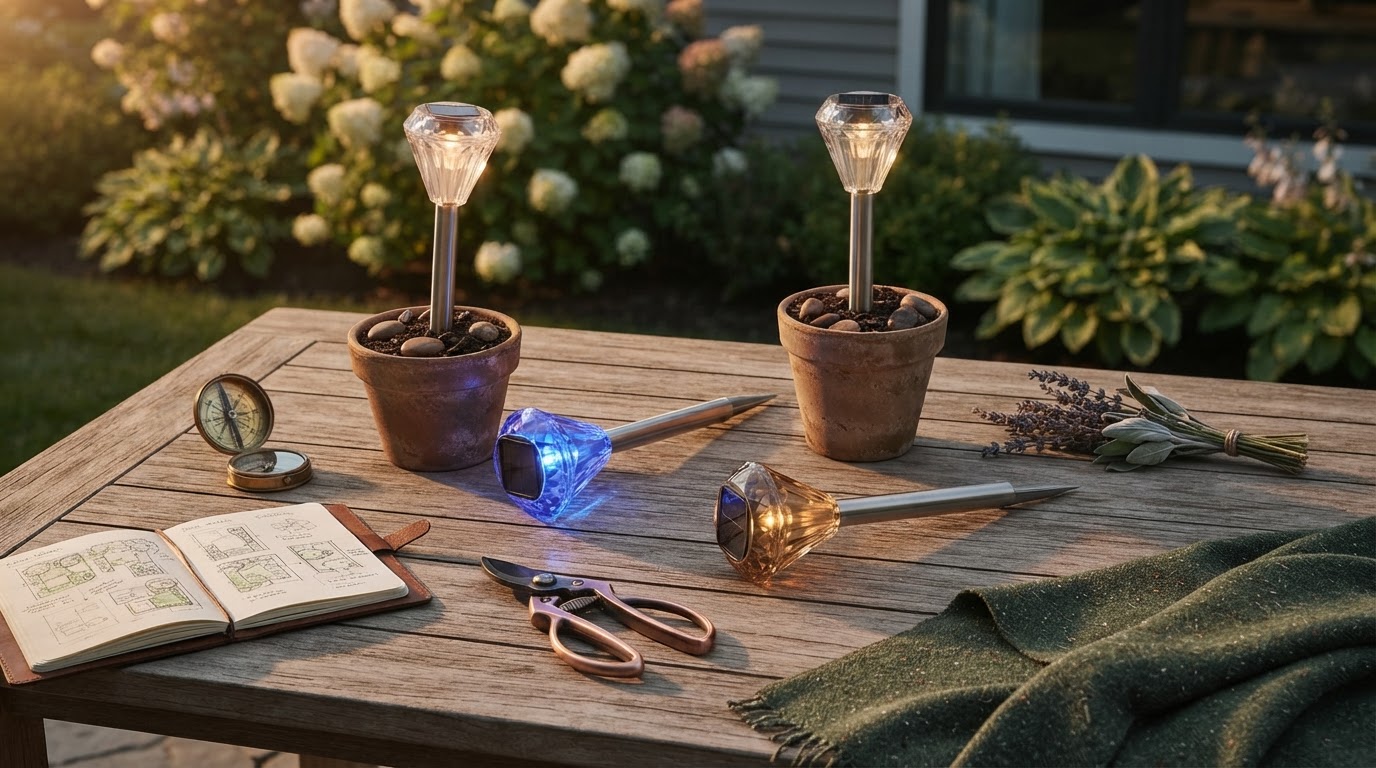
Solar Garden Color Lights for High-Lumen Outdoor Accents
 Maya ChenContributing Editor
August 11, 2026. This technical assessment examines the performance metrics of high-output color-changing solar spotlights. It is intended for property owners prioritizing visibility and color saturation over decorative ambient glow.
The Efficiency Gap in Residential Solar Illumination
The conventional wisdom says that solar lighting is a trade-off between convenience and actual utility. Most consumers assume that adding color reduces the effective brightness of a fixture to the point of being purely ornamental. However, the data suggests this limitation is often a result of poor panel-to-battery ratios rather than the inherent nature of LEDs. When evaluating brightness, the industry standard focuses on white light lumens, often ignoring how RGB diodes distribute power. According to Outdoorsolarstore.com, a high-output white solar spot light can reach 125 Lumens with a 3000K to 5700K temperature range, providing a baseline for what consumers should expect from a dedicated spotlight fixture. The problem arises when multi-color units attempt to mimic this intensity without the necessary surface area for photovoltaic collection.
Here's the part nobody talks about: many units labeled as "spotlights" are actually wide-angle floodlights with significant light bleed, which reduces the perceived brightness on the target object. In a waterproof rgb solar garden lights outdoor configuration, the intrusion of moisture often degrades the reflective housing before the battery fails, leading to a permanent drop in lumen output. To achieve actual spotlighting capabilities, a fixture must maintain a tight beam angle while drawing from a high-capacity lithium-ion cell. Without this, the "brightest" setting is merely a marketing claim that vanishes two hours after sunset. For those implementing rgb solar landscape lighting, the focus must remain on the discharge rate. If the unit cannot maintain peak brightness through the first six hours of darkness, it fails the basic requirements of architectural lighting.
Engineering Brightness in Solar Garden Color Lights
Photo by Maximilian Müller on Pexels
Solar Garden Color Lights addresses the brightness deficit by prioritizing diode density and optical clarity. Unlike generic alternatives that use frosted lenses to hide low-quality LEDs, these fixtures utilize clear, high-transmission optics to ensure the maximum amount of generated light reaches the foliage or facade. When analyzing colorful solar landscape spotlights, the distinction lies in the spectral power distribution. A high-quality RGB chip can produce vivid saturation without the washed-out appearance common in low-voltage solar components. Run the math: a fixture with a 5V/2W solar panel and a 2000mAh battery will consistently outperform the standard 1.2V Ni-MH setups found in big-box retail aisles.
Quntis RGB Color Changing Solar Spotlights, for example, offer up to 25 lighting modes and 8 colors, utilizing dual lenses to focus the beam, as noted in their technical specifications. This dual-lens approach is critical because it prevents the light scatter that typically makes solar units look dim from a distance. By concentrating the photon output, Solar Garden Color Lights ensure that the transition between colors remains sharp and the target remains illuminated. This is particularly relevant for rgb solar landscape lighting where the objective is to highlight specific textures, such as stone walls or specimen trees, rather than simply washing an entire area in a low-intensity glow. Furthermore, the integration of IP65 or higher weatherproofing ensures that the internal electronics do not suffer from the impedance increases caused by corrosion, which is the primary silent killer of brightness in outdoor solar arrays.
A Framework for Evaluating Solar Spotlight Performance
Photo by 🇻🇳🇻🇳Nguyễn Tiến Thịnh 🇻🇳🇻🇳 on Pexels
Selecting a spotlight requires moving past the aesthetic appeal and looking at the hardware durability. A bright light is useless if it cannot survive a standard rain cycle or if its color cycle defaults to a dim red every time the battery hits 50%. When integrating these units into a broader colorful solar landscape spotlights plan, the hardware must be evaluated on its ability to sustain a high-current draw. T-SUN Solar Spotlights have demonstrated in field reviews, such as those featured on YouTube, that waterproof ratings and beam adjustment are the two most significant factors in long-term user satisfaction. If the housing allows for vertical and horizontal adjustment, the user can maximize the "throw" of the light, making it appear brighter than a fixed-position unit with the same lumen count.
Before purchasing, use this technical checklist to verify the unit's capabilities:
- Verify the panel wattage: Look for a minimum of 1.5W to ensure the battery can actually reach full capacity during winter months.
- Check lens material: Polycarbonate or glass is preferred over cheap acrylic, which yellows and blocks light over time.
- Assess the beam angle: A true spotlight should have a beam angle between 15 and 45 degrees; anything wider is a floodlight.
- Evaluate the mounting hardware: Plastic stakes often snap; look for reinforced ABS or aluminum for stability in waterproof rgb solar garden lights outdoor installations.
- Confirm memory functions: The unit must remember its color setting after a power cycle to avoid daily manual resets.
Shop Solar Garden Color Lights here